Ceiling water damage in Las Vegas is caused most commonly by AC condensate drain overflows, monsoon roof leaks, upstairs bathroom plumbing failures, and attic supply line failures. The severity ranges from cosmetic staining (dry, old stains from a stopped source) to a structural emergency (sagging, soft, or actively wet ceilings that carry collapse risk from saturated drywall weighing 150 to 200 pounds per panel). Repair costs range from $200 to $600 for small cosmetic patches to $5,000 or more when attic insulation replacement and mold remediation are required. Las Vegas's extremely hard water (270+ PPM) accelerates AC condensate drain blockages, making this the highest-risk ceiling damage scenario during the May through October cooling season. A professional restoration company provides moisture assessment with thermal imaging and calibrated moisture meters throughout Henderson, Summerlin, North Las Vegas, Spring Valley, and Enterprise, identifying hidden ceiling cavity moisture that visual inspection alone cannot detect.
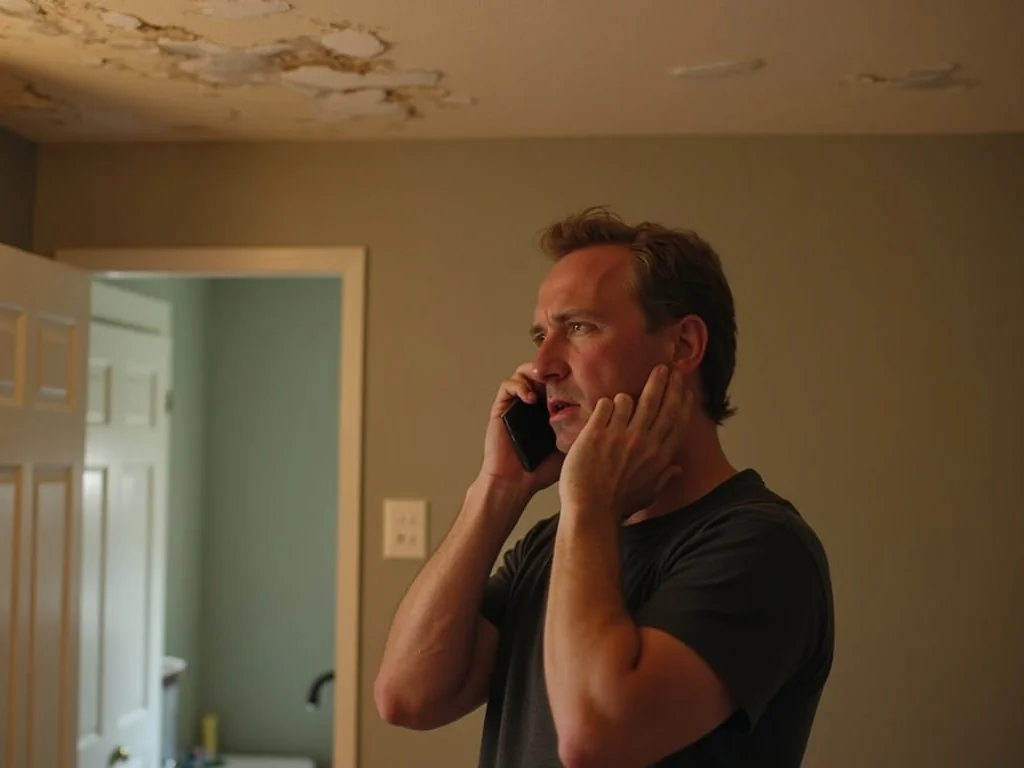
Ceiling Water Damage in Las Vegas: Causes, Repair Costs, and When to Worry
 July 15, 2026·9 min read·VegasRebuild Editorial
Quick Answer: Ceiling water damage in Las Vegas is caused most often by AC condensate overflows, upstairs bathroom leaks, roof leaks during monsoon season, and supply line failures in the attic. A small, dry stain may be cosmetic; a bulging, soft, or wet ceiling is a structural emergency. Saturated drywall can weigh several hundred pounds and collapse without warning. If your ceiling is sagging or wet, leave the area and call a licensed restoration company immediately.
A water stain on your ceiling is one of those things Las Vegas homeowners either ignore for months or panic about immediately, and both reactions are often wrong. The truth is that ceiling water damage ranges from a purely cosmetic issue requiring a coat of stain-blocking primer to a serious structural hazard that can collapse under its own weight. Knowing which situation you are in requires understanding the source, the current moisture content, and how long the problem has been developing. Las Vegas creates a specific set of ceiling water damage scenarios that are less common in other parts of the country. Our summers push AC systems to near-continuous operation from May through October, and condensate drain overflows are one of the most frequent sources of ceiling water damage in valley homes. Monsoon season from July through September brings brief but intense rainfall that exposes every weakness in a roofing system, and the flat and low-slope roofs common on Las Vegas homes are particularly vulnerable. Upstairs bathroom plumbing in two-story homes throughout Henderson and Summerlin causes ceiling damage in first-floor rooms more often than most homeowners realize. If you are looking at a ceiling stain or bulge and trying to decide what to do next, this guide gives you a practical framework for assessing severity, understanding the source, estimating repair costs for 2026 Las Vegas conditions, and knowing exactly when the situation requires an emergency call.

Written by David Reyes
Software engineer in Summerlin, Las Vegas. Built VegasRebuild after losing $34,000 to hidden mold.
The Most Common Causes of Ceiling Water Damage in Las Vegas
Understanding what is causing your ceiling damage is the first and most important step, because the source determines both the urgency of the situation and who is responsible for the repair. In Las Vegas, a relatively small set of causes accounts for the vast majority of ceiling water damage events, and each has a distinct seasonal pattern. AC condensate overflows are the single most common source of ceiling water damage in Las Vegas residential properties. Every central AC system produces condensation as it cools air, and that condensate drains through a primary and secondary drain line. During the Las Vegas cooling season, when units run 14 to 20 hours per day, the primary drain line can accumulate algae growth and mineral scale from Las Vegas's exceptionally hard water (averaging 278 parts per million), eventually blocking the line and forcing water out through the secondary drain or directly into the ceiling cavity. In homes where the air handler is located in the attic, an overflowing condensate pan will saturate attic insulation and eventually penetrate the drywall ceiling below. This scenario is most common in Spring Valley, Enterprise, and Henderson neighborhoods built from the 1990s through the 2010s where air handlers were routinely installed in attic spaces. Roof leaks during monsoon events are the second most common cause. Las Vegas's flat and low-slope tile or shingle roofs develop failure points at penetrations (vent pipes, skylights, HVAC curbs), at flashing transitions, and at areas where tiles have cracked or shifted in the extreme heat. A roof that has no visible problem during the dry months can leak dramatically during a monsoon event producing one inch of rain in 30 minutes.
- •AC condensate overflow: the most common cause in Las Vegas, especially in homes with attic-installed air handlers; peaks June through September.
- •Roof leaks at penetrations, flashing transitions, or cracked tiles: most visible during monsoon season (July through September).
- •Upstairs bathroom supply line or drain failures: toilet supply lines, shower valve connections, and tub drain assemblies in second-floor bathrooms directly above first-floor ceilings.
- •Attic plumbing supply line failures: some Las Vegas homes route supply lines through the attic space, where extreme heat accelerates deterioration of flexible connections.
- •HVAC refrigerant line condensation: improperly insulated refrigerant lines in the attic can sweat and drip in specific temperature and humidity conditions.
- •Neighbor unit plumbing failures (condos and multi-family): leaks from units above are among the most common causes in Henderson and Summerlin condominium communities.
- •Swamp cooler water supply lines: in older North Las Vegas and Spring Valley homes that use evaporative cooling, water supply failures on the roof unit are a common cause.
Assessing Severity: Cosmetic Stain Versus Structural Emergency
The difference between a cosmetic ceiling stain and a structural emergency comes down to two factors: current moisture content and the degree of material saturation in the drywall and framing above. A stain that has been present for months and is dry to the touch, with no soft spots, no sagging, and no ongoing source, is almost certainly cosmetic. The water intrusion event that caused it has stopped, the materials have dried out (at least superficially), and the remaining damage is the mineral deposit and staining left behind. A repair in this scenario is mostly cosmetic. The scenarios that require immediate action look very different. A ceiling that is actively dripping, a ceiling with any visible sagging or bulging, a ceiling area that feels soft or spongy when touched lightly, or a ceiling with visible discoloration spreading over time all indicate active moisture that has not dried. Saturated drywall is a collapse hazard. A single 4x8 sheet of half-inch drywall weighs about 54 pounds dry. When saturated with water, that same panel can weigh 150 to 200 pounds or more, and the paper and gypsum core that hold it together degrade rapidly when wet. Las Vegas's concrete slab construction means that most ceilings are drywall hung on metal or wood framing with no wood subfloor above to provide structural backup. When saturated drywall fails, it fails catastrophically and without warning. If you push gently on any portion of a wet-looking ceiling and it feels soft, move everyone out of that room and call a licensed restoration company before doing anything else.
- •Dry stain with no soft spots, sagging, or ongoing source: likely cosmetic; repair involves stain-blocking primer and paint.
- •Wet stain, active dripping, or spreading discoloration: active moisture, source must be identified and stopped before any repair.
- •Any sagging or bulging in the ceiling: structural emergency; evacuate the area immediately and do not re-enter until a professional has assessed the situation.
- •Soft or spongy feel when touched lightly: saturated drywall; collapse risk is real and the area must be vacated.
- •A saturated 4x8 sheet of half-inch drywall can weigh 150 to 200 pounds; paper and gypsum core degrade rapidly under sustained saturation.
- •Musty odor in a room with a ceiling stain: mold may already be growing inside the ceiling cavity above the stain; professional moisture assessment is needed.
- •Any ceiling near a light fixture, electrical outlet, or ceiling fan with water damage should be treated as an electrical hazard until a licensed electrician inspects it.
AC Condensate Overflow: Las Vegas's Most Common Ceiling Damage Source
Because AC condensate overflows account for such a disproportionate share of ceiling water damage in Las Vegas, this source deserves detailed treatment on its own. The mechanics are straightforward. Your central AC system's air handler coils produce several gallons of condensation per day during peak cooling season. That water drains through a primary PVC drain line to a floor drain, laundry standpipe, or exterior. As that primary line accumulates algae growth and hard water scale (Las Vegas's water is among the hardest in the country at over 270 PPM), it eventually becomes restricted or fully blocked. At that point, water backs up into the condensate pan beneath the air handler. If the primary drain blockage is not caught quickly, water overflows the pan. In an attic installation, that overflow saturates attic insulation, which acts as a sponge, slowly releasing water into the ceiling drywall below. The insulation masks the problem initially, and by the time a ceiling stain appears, significant saturation may already have occurred in the attic space. Preventing this failure is simple with annual maintenance: flush the primary drain line with diluted bleach each spring, install a float switch on the secondary drain that shuts off the AC before overflow occurs, and confirm the condensate pan is level. If your system is more than 10 years old and has never had the drain line serviced, schedule that service before the June heat arrives. If you are currently seeing a ceiling stain below your attic AC unit during or after a period of heavy cooling use, an overflowing condensate system is the most probable cause and should be your first investigation point.
- •Las Vegas AC systems produce several gallons of condensate per day during peak season (May through October).
- •Las Vegas hard water (270+ PPM) accelerates scale buildup in primary condensate drain lines, causing earlier blockages than in other regions.
- •When the primary drain line blocks, water overflows the condensate pan and saturates attic insulation before reaching the ceiling drywall.
- •Attic insulation acts as a buffer that masks the problem; ceiling stains may not appear until saturation is already significant.
- •Prevention: flush primary drain with diluted bleach each spring, install a float switch on the secondary drain, confirm the condensate pan is level.
- •Ceiling stains in a room directly below an attic air handler that appear during heavy AC use are almost certainly condensate overflow until proven otherwise.
- •A float switch that shuts off the AC when the secondary drain begins to fill costs $20 to $50 to install and can prevent thousands of dollars in ceiling damage.
Ceiling Water Damage Repair Costs in Las Vegas for 2026
Repair costs for ceiling water damage in Las Vegas depend on the size of the affected area, the depth of moisture penetration into attic insulation and framing, whether mold remediation is required, and the ceiling finish type. Smooth drywall, textured finishes, and popcorn ceilings each have different repair cost profiles, and matching an existing texture in an older Las Vegas home can add labor cost above the base repair. For a small, cosmetically damaged area under 10 square feet where the source has been fixed and the drywall is dry, a patch and repaint runs $200 to $600 depending on texture complexity. For a larger area of 20 to 50 square feet requiring drywall replacement (cut out the affected section, install new panel, tape, mud, sand, texture, and paint), expect $600 to $1,500. When the source is an AC condensate overflow that has saturated attic insulation, the repair scope expands significantly. Removing and replacing wet attic insulation adds $800 to $2,500 depending on R-value specification and square footage. If the framing above the ceiling sustained moisture exposure and mold has developed, professional mold remediation of the attic space adds $1,500 to $5,000 before reconstruction begins. Popcorn ceiling texture, common in Las Vegas homes built through the 1980s and 1990s, complicates repair because matching the existing texture is difficult and the texture may contain asbestos in pre-1978 construction, requiring asbestos testing ($50 to $150 per sample) and potentially licensed abatement ($1,500 to $5,000) before repair work can proceed.
- •Small cosmetic patch under 10 sq ft (dry, source fixed): $200 to $600.
- •Larger drywall replacement section 20 to 50 sq ft: $600 to $1,500.
- •Attic insulation removal and replacement after condensate overflow: $800 to $2,500.
- •Mold remediation of attic framing before reconstruction: $1,500 to $5,000 depending on extent.
- •Popcorn ceiling repair: more expensive due to texture matching difficulty; pre-1978 popcorn ceiling may require asbestos testing ($50 to $150 per sample).
- •Licensed asbestos abatement if required: $1,500 to $5,000 before drywall repair can proceed.
- •Full ceiling replacement in a standard Las Vegas room (12x14 ft): $1,500 to $3,500 depending on finish type and accessibility.
Mold Risk After Ceiling Water Damage in Las Vegas
Las Vegas's desert climate produces a counterintuitive mold dynamic. The ambient outdoor humidity is very low, which dries surfaces quickly. But trapped moisture inside a ceiling cavity, surrounded by insulation that retains moisture and a drywall surface that has organic paper facing, creates exactly the localized humid environment that mold needs. In the attic space above a condensate overflow, summer temperatures can exceed 160 degrees Fahrenheit during the day, but the wet insulation keeps the immediate surface of the framing and drywall cool enough to support mold growth. This means that ceiling water damage from AC condensate events, which peak during Las Vegas's hottest months, is also the highest-mold-risk scenario you can face. Mold can begin growing within 24 to 48 hours of sustained moisture intrusion. Inside a ceiling cavity where the moisture is not visible and drying air cannot reach, conditions can remain mold-favorable for weeks after the external stain first appears. If there is any musty odor in the affected room, if the stain has been present for more than a week, or if the ceiling feels soft or has any active moisture, professional moisture mapping with thermal cameras and calibrated meters is the only reliable way to determine whether mold is present inside the cavity. Visual inspection alone is not sufficient. A professional restoration company performs moisture assessment throughout the Las Vegas valley, including Henderson, Summerlin, North Las Vegas, Spring Valley, and Enterprise. Early assessment is always less expensive than addressing mold discovered during a later renovation.
- •Las Vegas's low ambient humidity does not prevent mold inside ceiling cavities; trapped moisture creates locally humid conditions regardless of outdoor humidity.
- •Attic temperatures above a condensate overflow can exceed 160 degrees during the day but the wet insulation keeps mold-prone surfaces at a cooler, mold-favorable temperature.
- •Mold can begin growing within 24 to 48 hours of sustained moisture intrusion inside a ceiling cavity.
- •Musty odor in a room with a ceiling stain is a strong indicator of mold growth inside the cavity above the stain.
- •Visual inspection cannot determine whether mold is present inside a ceiling cavity; thermal imaging and moisture meters are required for accurate assessment.
- •Ceiling water damage present for more than one week without professional assessment carries a high mold probability in Las Vegas summer conditions.
- •Early professional assessment is consistently less expensive than mold remediation discovered during a later renovation; do not delay having a wet or stained ceiling evaluated.
What to Do When You Find Ceiling Water Damage in Your Las Vegas Home
Finding ceiling water damage prompts a clear sequence of actions, and the order matters. Your first action is to assess whether the ceiling is dry or actively wet. If the ceiling is sagging, soft, or actively dripping, evacuate the area immediately. Do not attempt to support the ceiling or puncture it yourself; a saturated drywall ceiling can collapse suddenly and the weight is enough to cause serious injury. Call a licensed restoration company and describe what you see; their emergency response team handles exactly this situation 24 hours a day throughout the Las Vegas valley. If the ceiling appears dry and the stain is old, your investigation priority is identifying the source. For single-story Las Vegas homes with attic air handlers, inspect the condensate pan under the air handler (requires attic access) and look for water marks in the insulation above the stained area. For two-story homes where the stain is directly below an upstairs bathroom, run the shower, flush the toilet, and use the sink, watching the ceiling below for any change. For stains near the exterior walls or near a chimney, roof leak is the most probable source and a licensed roofer should inspect the area above the stain. Once the source is identified and stopped, do not paint over the stain until you have confirmed with moisture meter readings that the drywall and framing above are fully dry. Painting over wet or damp drywall traps moisture and accelerates mold growth inside the cavity, turning a manageable repair into a significantly more expensive remediation project.
- •Sagging, soft, or actively dripping ceiling: evacuate the area immediately and call a licensed restoration company.
- •Dry stain on a single-story home with attic air handler: check the condensate pan and insulation in the attic above the stained area first.
- •Stain below an upstairs bathroom: run all plumbing fixtures and watch the ceiling below; active dripping during use confirms a drain or supply line source.
- •Stain near an exterior wall or chimney: roof leak is the most probable source; schedule a licensed roofer inspection during or immediately after the next rain event.
- •Never paint over a ceiling stain without confirming drywall is fully dry with moisture meter readings; painting traps moisture and accelerates hidden mold growth.
- •Photograph the stain and any surrounding area before any repair work begins; if a neighbor or landlord is responsible, this documentation is your evidence.
- •Any ceiling stain that has grown or spread since you first noticed it indicates an ongoing or intermittent water source that must be identified before any repair.
Frequently Asked Questions
The most common causes in Las Vegas are AC condensate drain overflows (especially in homes with attic air handlers), roof leaks during monsoon season, upstairs bathroom supply line or drain failures, and attic plumbing line failures. AC condensate is the leading cause from May through October because Las Vegas systems run nearly continuously, and the valley's extremely hard water accelerates drain line blockages.